
Standards
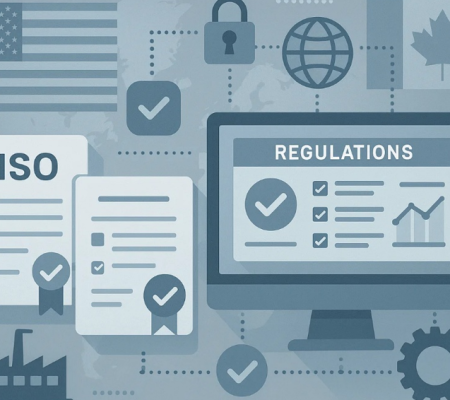
Explore essential U.S., Canadian, and global standards that ensure secure, reliable, and scalable IIoT and M2M implementations.
Overview
The Consortium of Industrial IoT and M2M is committed to promoting the development and adoption of secure, scalable, and standards-compliant technologies across the Industrial IoT (IIoT) and Machine-to-Machine (M2M) sectors. Our goal is to help organizations implement reliable IIoT frameworks that align with global, U.S., and Canadian regulations, while fostering innovation and accelerating digital transformation.
Headquartered in Portland, OR, the Consortium brings together a diverse network of forward-thinking companies that collaborate to design, develop, and deploy advanced technologies and services. We prioritize regulatory compliance, cybersecurity, interoperability, and system quality to ensure our members meet the evolving demands of their industries. Through joint technology initiatives, customer support, and integrated marketing and sales strategies, we empower sectors such as manufacturing, energy, transportation, and logistics to achieve operational excellence within a compliant and future-ready ecosystem.

Key International, U.S., and Canadian Standards and Regulations
International Standards
ISO/IEC 30141 – IoT Reference Architecture
Provides a standardized architecture framework for IoT systems to ensure interoperability and scalability across diverse devices and applications.
ISO/IEC 27001 – Information Security Management
Specifies requirements for establishing an information security management system, essential for protecting sensitive IIoT data.
IEC 62443 – Industrial Communication Networks – IT Security
Offers a multi-part standard focusing on cybersecurity in industrial automation and control systems, widely adopted in IIoT.
ITU-T Y.2060 – IoT Overview
Defines the fundamental aspects of IoT, including architecture, security, and application support, guiding cross-border implementations.
GS1 Standards
Enables unique identification and data sharing among IoT-connected devices through standardized barcodes and EPC/RFID tags.
United States Standards and Regulations
NIST SP 800-53 – Security and Privacy Controls
Published by the National Institute of Standards and Technology, this framework outlines essential controls for securing federal information systems and IIoT networks.
NIST Cybersecurity Framework (CSF)
Provides voluntary guidance for managing cybersecurity risks and is widely adopted by private industries deploying IIoT systems.
FCC Part 15 – Radio Frequency Devices
Regulates unlicensed wireless transmissions used in IIoT devices to prevent harmful interference in the U.S. communications spectrum.
OSHA Standards for Machine Safety
Establishes requirements for industrial equipment safety, including sensors and connected systems used in IIoT environments.
UL 2900 Series – Software Cybersecurity for Network-Connectable Products
Evaluates cybersecurity risk in connected systems and software used in Industrial IoT environments.
Canadian Standards and Regulations
CSA Group (Canadian Standards Association) – CSA C22.2 No. 213
Specifies safety standards for industrial electrical equipment, including wireless IIoT devices used in hazardous locations.
ISED Canada – RSS and ICES Standards
Innovation, Science, and Economic Development Canada regulates radiofrequency emissions from IoT devices, ensuring electromagnetic compatibility.
PIPEDA – Personal Information Protection and Electronic Documents Act
Governs how businesses handle personal data collected via connected devices and IIoT platforms, emphasizing user consent and transparency.
CAN/CSA-IEC 62443
Adopted Canadian version of the IEC 62443 series, used to guide industrial cybersecurity practices and compliance for IIoT systems.
Canadian Energy Efficiency Regulations
Influences the design of IIoT-based energy monitoring systems to meet national energy conservation goals.
How the Consortium of Industrial IoT and M2M Helps
We help clients implement IIoT and M2M solutions that meet stringent regulatory standards while maintaining operational agility. By uniting engineering expertise and compliance knowledge, the Consortium of Industrial IoT and M2M delivers systems that are both innovative and aligned with evolving standards across borders. Our experience spans multiple industries, ensuring that your solutions are built with quality, security, and compliance at the forefront.
Need help navigating complex regulations or
building standards-compliant IIoT systems?
opportunities, or more details on how we can help your business succeed in a connected world.